维贝编码易. 从中赚钱是困难的部分——这是实用开发者指南
Vibe Coding Is Easy. Making Money From It Is the Hard Part — Here’s a Practical Developer Guide
维贝编码易. 今日的开发者可以做一些几年前听起来很荒谬的事。 您可以在周五晚间打开一个 AI 编码工具,描述一个想法, 到周日有: 登陆页面认证一个数据库 一个API支付一个仪表板部署 也许甚至一个移动应用程序 这是不可思议的。 但有一个不舒服的问题。 这些都意味着任何人都不会付你钱 AI大幅降低了软件的构建难度. 它并没有减少寻找一个真正的问题的困难,联系到合适的人,赢得他们的信任,定价你的产品,并说服某人进入他们的信用卡. 我认为这里有很多开发商被困住。 堆叠...
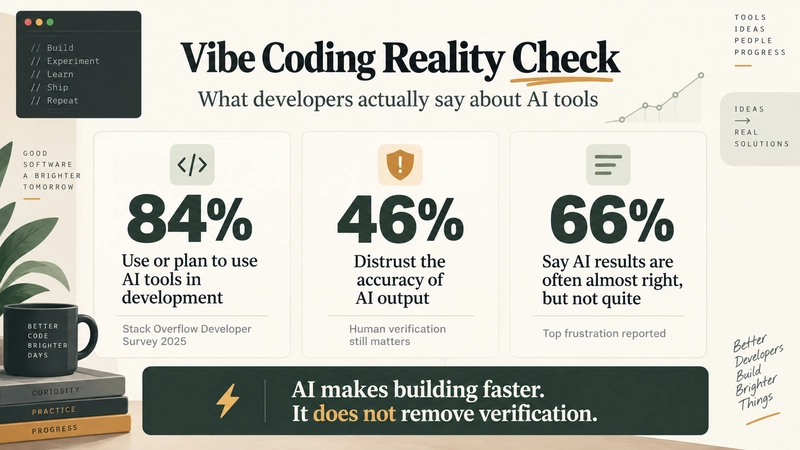
Vibe Coding Is Easy. Making Money From It Is the Hard Part — Here’s a Practical Developer Guide A developer today can do something that would have sounded ridiculous a few years ago. You can open an AI coding tool on Friday evening, describe an idea, and by Sunday have: a landing page authentication a database an API payments a dashboard deployment maybe even a mobile app That is incredible. But there is an uncomfortable problem. None of those things mean anyone will pay you. AI has dramatically reduced the difficulty of building software. It has not reduced the difficulty of finding a real problem, reaching the right people, earning their trust, pricing your product, and convincing someone to enter their credit card. And this is where I think a lot of developers are getting stuck. Stack Overflow's 2025 Developer Survey found that 84% of respondents use or plan to use AI tools in development, while 51% of professional developers use them daily. At the same time, 46% said they distrust the accuracy of AI output. So yes, AI development is real. But: Being able to generate software faster is not the same skill as being able to create a business. If you are a developer experimenting with vibe coding and wondering how this can realistically turn into income, here is the process I would follow. Step 1: Don't Start With an App Idea This sounds strange. We're developers. Naturally, our brain starts like this: Try changing the question to: That small change matters. Imagine these two ideas. Idea A An AI-powered productivity dashboard with 17 widgets. Sounds cool. But who desperately needs it? Why would they pay? What are they currently using? No idea. Idea B Small marketing agencies spend hours every Friday manually combining advertising numbers from multiple sources into client reports. Now we have something interesting. There is: a specific user a repeated task wasted time an existing workflow potentially measurable value You aren't selling software. You're selling: That's much easier to understand. Step 2: Look for Problems Where Money Already Moves One of the biggest mistakes we make is trying to invent demand. Instead, look for places where people already pay for: employees freelancers agencies subscriptions spreadsheets consultants repetitive manual work Those are signals. Suppose a business currently pays someone $300 every month to manually perform a repetitive task. If you build a tool that reliably handles most of that workflow for $39/month, you aren't trying to convince them that the problem exists. They already know it exists. You're offering another way of solving it. This is very different from building: "AI-powered social network for developers." Nobody knows whether they need that. Step 3: Find the Problem Before You Open Cursor Before touching your AI coding tool, spend a few hours investigating. Look at places where your target customers complain naturally. For developers, that might mean: GitHub Issues Reddit Stack Overflow Dev.to Hacker News Discord communities For businesses: Reddit LinkedIn Facebook groups industry forums software reviews job descriptions freelancer marketplaces Search for phrases like: Those sentences are often more valuable than another list of "50 SaaS ideas." Step 4: Talk to People Before Building Too Much Developers hate this step. Because coding feels productive. Messaging strangers feels uncomfortable. But five conversations with people who experience the problem can save you five weeks of coding. Ask questions like: Notice what I didn't ask: "Would you use my AI SaaS?" People are usually nice. They might say yes. That doesn't mean they will pay. Ask about their existing behavior, not their imagined future behavior. Step 5: Pick One Painful Workflow AI makes feature creation cheap. That makes overbuilding even more tempting. Your first version probably does not need: It might need one button. For example: If that workflow saves someone meaningful time every week, you already have a product. You can add everything else later. Step 6: Now Use Vibe Coding Aggressively This is where AI becomes extremely useful. Once the problem is clear, use AI to reduce the time between idea and customer feedback. Instead of spending four months building version one, try getting something testable online much sooner. A simple stack might look like: And your AI workflow might be: Notice something important. This is not: Stack Overflow's survey found that the biggest AI frustration among developers was receiving solutions that were almost right but not quite, reported by 66% of respondents. Another 45% said debugging AI-generated code could be more time-consuming. AI gives you speed. Your engineering knowledge gives you confidence. You need both. Step 7: Put a Price on It Earlier Than Feels Comfortable This is where many side projects quietly die. They launch with: Then the developer gets: A paying customer teaches you something a free signup cannot. Someone saying: "This looks useful." is nice. Someone saying: "Here's $19." is evidence. Stripe's current SaaS pricing guidance recommends aligning pricing with the value customers receive rather than simply calculating your development cost. Think about the outcome. If your software saves a freelancer five hours every month, the question isn't: "How much did the API cost me?" The better question is: "What is five hours worth to this customer?" Keep Early Pricing Simple Don't start with this: Try: Or maybe: You can optimize pricing after you understand usage. Stripe also points out that overly complicated SaaS pricing can create decision friction, while pricing should reflect what customers value and how they use the product. Step 8: Don't Wait for Product Hunt to Save You You built it. You deployed it. You posted: "After three months of work, I'm excited to launch..." And then... Welcome to software distribution. This might be the biggest mindset change developers need. A recent Indie Hackers discussion about first paying customers showed the same frustration: founders often find the first sale harder than the actual product development. One founder said direct outreach to a very specific niche worked better than attracting hundreds of random visitors. Another founder who built software for managing many websites described reaching the same conclusion: building technical products was familiar, but getting attention was a completely different skill. That's important. Because when building becomes cheaper, distribution becomes relatively more valuable. Step 9: Get Your First 10 Users Manually Forget automation for a moment. Find 10 people. Not 10,000. Ten. If your product helps recruiters, find recruiters. If it helps Shopify store owners, find Shopify store owners. If it helps agencies, find agencies. Send something like: Don't write: Nobody wants that message. Talk like a human. Step 10: Sell the Result, Not the AI This is especially important now. People do not necessarily care that your product uses: They care about what changes after using it. A recent Indie Hackers founder described landing an early customer for an AI customer-support product after focusing the conversation on the customer's slow lead-response time rather than selling "AI." That lesson applies to almost everything. Don't sell: AI invoice intelligence. Sell: Turn 200 invoices into a clean monthly report in five minutes. Don't sell: Agentic email automation. Sell: Automatically follow up with leads you forgot to reply to. Don't sell: LLM-powered resume optimization. Sell: Tailor your resume to a job description in 60 seconds. Technology explains how. Customers buy why. Step 11: Your First $100 Is More Important Than Your First 1,000 Users Imagine two projects. Project A Project B Which one would you rather investigate further? For me: Project B. Those four customers have answered one extremely important question: Will anyone exchange money for this? A founder recently described their first $69 customer in a similar w