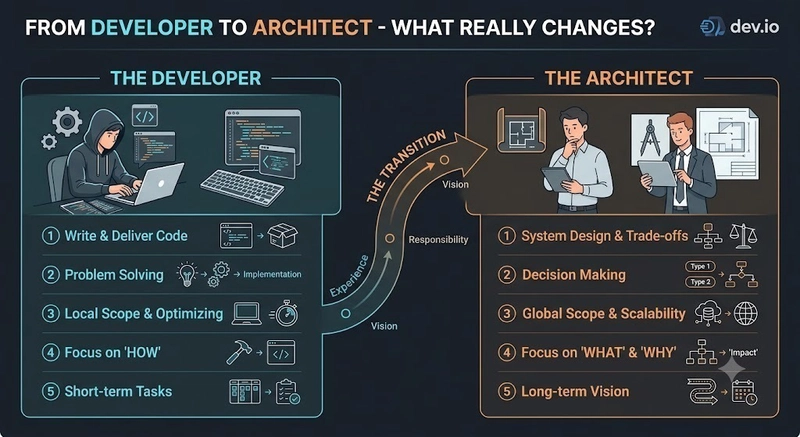
One of the biggest transitions in a software engineer’s career is moving from “How do I implement this?” to “How should we design this?” As developers, we naturally focus on writing clean code, implementing features, fixing bugs, and improving performance.
But as you move toward an architect role, the questions become different: 🔹 Scalability — Will this solution work when the number of users or transactions increases 10x? 🔹 Maintainability — Can another team understand and extend this solution two years from now? 🔹 Security — Are authentication, authorization, data protection, and secrets management considered from the beginning? 🔹 Performance — Where could bottlenecks occur, and how can we identify them before they become production issues? 🔹 Resilience — What happens when a dependent service goes down? 🔹 Integration — How will this solution interact with existing enterprise systems? 🔹 Technology choices — Does the technology solve the actual business problem, or are we choosing it simply because it is popular? 🔹 Trade-offs — What are we gaining, and what are we giving up with each architectural decision?
A senior developer asks: “How can I build this feature?” An architect asks: “What is the right solution for the business, technical, operational, and long-term requirements?” The most important lesson I’ve learned is that architecture is not about creating complicated diagrams or using more technologies.
Good architecture is about making the right decisions at the right level, understanding trade-offs, and creating solutions that can evolve with the business.
And you don't suddenly become an architect because of a designation.
You gradually become one by thinking beyond your code.
Java #SoftwareArchitecture #SpringBoot #Microservices #SoftwareEngineering #JavaDeveloper #TechnologyLeadership #Architect