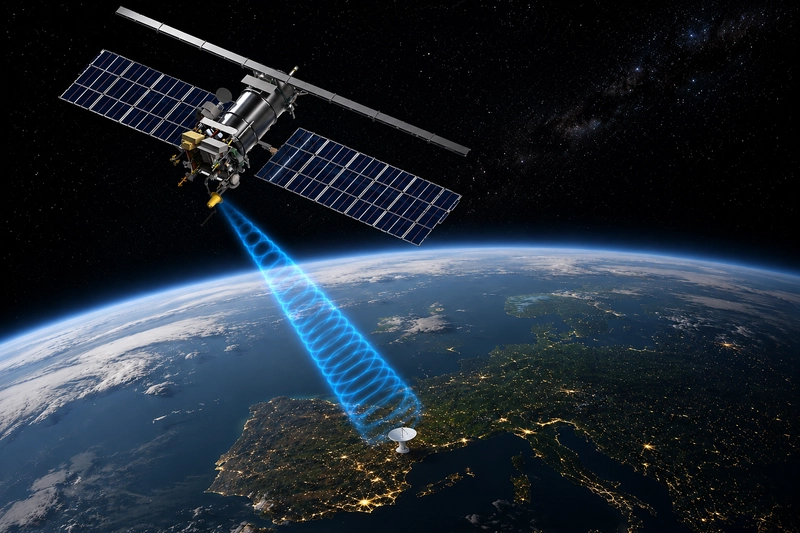
The Antenna That Wouldn't Stop Growing
Prologue: Open the window and look at the sky 🌌 Right now, while you read this, multi-million euros satellites are passing over your head. Some of them are transmitting pictures of the Earth to anyone who cares to listen. Not to their partner companies. Not to governments. To anyone. The images go out unencrypted, raining down over whole continents on frequencies you can pull in with about 100 euros of hardware and a balcony facing the sky. That is true for Earth pictures, for weather data, aviation/maritime tracking, amateur radio, even videos from the International Space Station 🛰️! I didn't know that either... until I did! And when I did, I felt a new frontier opening up, like I could reach the stars for real, from my home. New space adventures and discoveries were expecting me, one...
Prologue: Open the window and look at the sky 🌌 Right now, while you read this, multi-million euros satellites are passing over your head. Some of them are transmitting pictures of the Earth to anyone who cares to listen. Not to their partner companies. Not to governments. To anyone. The images go out unencrypted, raining down over whole continents on frequencies you can pull in with about 100 euros of hardware and a balcony facing the sky. That is true for Earth pictures, for weather data, aviation/maritime tracking, amateur radio, even videos from the International Space Station 🛰️! I didn't know that either... until I did! And when I did, I felt a new frontier opening up, like I could reach the stars for real, from my home. New space adventures and discoveries were expecting me, one satellite at a time. This is a story about reaching (weather imagery) satellites. It's also a story of how a "let me just try one thing" turned into a distributed ground station running across two countries, a dead laptop resurrected as a server, my dad on a ladder in Théding while I watch from Barcelona and, as I write this, a geostationary satellite drifting slowly across the sky toward the one spot that would let me receive it. The project isn't finished. I mean that literally: this article ends on a spacecraft that is still in motion. But I should introduce the cast first, because the difference between two kinds of satellite is the key to this whole project. Weather satellites come in two families. The first are polar orbiters 🛰️. They fly low, a few hundred kilometers up, and fast, looping North to South while the Earth turns underneath them, so they eventually pass over everywhere (over your home too! 👾). They're the ones I chase in this story: the Russian METEOR-M series, 800 km over our heads, broadcasting down in the VHF band around 137 MHz. The catch is they're only up there for about ten to fifteen minutes at a time. The satellite climbs out of the horizon, arcs over us, and drops away, and we have exactly that long to grab everything it's saying before it's gone. Miss it and you wait for the next orbit (~ 1-2 days!). The second family are geostationary satellites 🌍. These sit ridiculously far out, about 36,000 km, in an orbit tuned so precisely that they circle the Earth in exactly one day, which means from the ground they appear to hang perfectly still. Fixed in the sky. Always there, always staring at the same face of the planet, broadcasting continuously. No ten-minute window 🤩. But they transmit way up in the L-band (~1.7 GHz), which is a different beast to receive. Hold onto these, they're where the story is heading, and the finale is one of them, the Elektro-L3 literally sliding into position. Chapter 1: "What if I just point an antenna at the sky?" The mission was clear, it was time for the first try: I bought a cheap RTL-SDR USB dongle, the kind that ships with a little telescopic dipole antenna in the box, extended and propped the antenna on my terrace, pointed it in a "looks about right" manner at the sky, waited for a METEOR pass, and hit record. Let me tell you about that dongle, because it's genuinely one of my favorite facts in this hobby. 🤓 Cool facts for the techies: the little RTL-SDR receivers that this entire community is built on were never designed to be radios. They started life as cheap DVB-T television tuners, USB sticks for watching digital TV on your laptop. Around 2012, people poking at the chip realized you could bypass the TV decoding and get at the raw radio samples underneath, the unprocessed digitized signal, straight off the antenna. Suddenly a 60€ TV stick became a general-purpose software-defined radio. It grabs a slice of radio spectrum, digitizes it, and shovels the raw numbers into your computer. Every actual radio thing, tuning, filtering, demodulating, turning a wobble in a signal into a pixel, happens in software, on your machine. So, in a sense, it does much less than a radio, it effectively is barely more than an antenna, and let you do the smart job with whatever signal you capture. Which is beautiful, and also means that when it doesn't work, there's no "radio" to blame. It's just you. And it did not work. The satellite came over, right on schedule (more on why the schedule is so exact in a later chapter). I recorded the pass. I ran the decoder. And out came... this: You see this near-black strip above 👆, that's the image I got. Not even a rectangular black image. Ten minutes of a satellite broadcasting a picture of Europe directly over my head, and I'd caught a black chopstick 🥢. But that first, hmm, something, mattered, once I understood what I was looking at. It wasn't random. It was the fragment of the satellite pass where the signal briefly clawed its way above the noise: the moment the satellite was highest and closest, fighting through the least air and distance. Everywhere else, when it was low on the horizon and far away, its signal never climbed above the city's radio racket, and the decoder had nothing to work with but static, which it faithfully rendered as black ⬛️. The image wasn't a total failure, as it helped me diagnose my problem. My problem was signal 📶. Or rather, the lack of it, the satellite is a few hundred kilometers up transmitting a handful of watts, and by the time that whisper reached a dipole antenna extended to some arbitrary length and pointed vaguely upward, it was already down in the mud with all the background radio noise of a city. The decoder needs the signal to stand above that noise floor to reconstruct a picture. Mine barely did, once, at the top of the pass, and drowned everywhere else. That black strip of radio noise wasn't exactly inspiring. But if the difference between black and a real picture was just signal quality, well, that was a problem with knobs on it. Knobs I could turn. And the first knob had been in the box the entire time. It wasn't that I'd skipped the antenna, I'd used the one that came with the kit. It was that I'd treated it like an accessory when it was actually an instrument. A dipole isn't a piece of wire you point at things; it's a tuned object whose length is supposed to correspond to the wavelength you're trying to catch. Mine was tuned to nothing in particular... 🔧 Build notes: the absolute minimum to try this yourself This is the naive setup that got me a black frame, deliberately bare-bones. It's still a perfectly good way to take your first swing, as long as you expect the black strip as a rite of passage rather than a failure. Receiver: an RTL-SDR Blog V3, the same dongle I run at both my sites. Get a proper "Blog" brand one, not the cheapest no-name stick: the good ones have a stable temperature-compensated oscillator (less frequency drift) and a built-in bias-tee you'll want in Chapter 3. Mine cost about 60€ delivery to Spain included with the dipole kit. Antenna: the telescopic dipole kit that comes with it is genuinely all you need to start... if you set it up properly, which I did not. How to actually dimension and orient it is the whole of Chapter 2. Target: METEOR-M2-3 and M2-4, downlink around 137 MHz VHF. (The exact per-satellite frequency comes in a later build-note, get it wrong and you'll record ten clean minutes of nothing. Ask me how I know.) Software: SatDump does capture and decode. First run: point it at the frequency, record the pass, decode. The full first-decode recipe and the config-crash gotcha that cost me an evening lands in Chapter 4. When to record: a pass is a ~10-minute window, look it up in advance. Pass prediction is covered in Chapter 4. Expectation setting: with an untuned antenna in a city, black-to-barely-there is the normal first result. The rest of this article will tell you how to get your first actual earth image. Chapter 2: "The antenna, that stick that's so much more than a stick" 📡 It turned out the antenna had a manual. I had not read the manual. The dipole that ships with the RTL-SDR ki