SAM3 → ONNX → Triton Inference Server: full image-model deployment (text, box + cross-crop exemplars, interactive PVS)
Sharing a deployment path that I couldn't find elsewhere in the issues here: SAM3's image model exported to ONNX and served on NVIDIA Triton Inference Server, with the full prompting surface exposed as runtime inputs.
https://github.com/ilanmotiei/sam3-triton (MIT)
Several excellent ONNX/TensorRT exports already exist (#224, #159). What this adds is the serving layer — real ONNX graphs on Triton's ONNX backend with config.pbtxt and ensembles, rather than a python-backend wrapper around the PyTorch code — plus the parts of the image model that usually get dropped in an export.
The split
images_u8[1,3,H,W] ─► sam3_unified_encoder ─► 7 vision tensors ┐
token_ids[1,32] ────► sam3_text ────────────► 3 text tensors  ─┼─► sam3_decoder ─► sam3_postprocess ─► RLE
box / concept exemplars ─► gate ────────────► 3 tensors ───────┘- The ViT backbone (~1.9 GB) runs once per image; every prompt is a cheap runtime input on the grounding head.
- One backbone serves both heads — the grounding neck and the PVS (interactive) neck — instead of shipping two ~1.9 GB encoders.
- SAM3's BPE tokenizer can't be represented in ONNX, so it stays client-side and the ensemble takes
token_ids. Since it pads to 32, every text tensor is fixed-shape — no dynamic axes anywhere.
What it covers
| text prompts | open-vocabulary, prompt is a runtime input |
| box exemplars | positive and negative, in the same image |
| cross-crop concepts | encode an appearance on crop A, reuse it on crop B (see below) |
| multi-keyword | encode once, decode per keyword server-side |
| interactive (PVS) | point / box / mask prompts, plus automatic mask generation |
The cross-crop concept split
This one was the interesting part. In sam3_decoder, the geometry encoder lives inside the graph and pools the current image's features at the box — so a box exemplar is a pointer into the image being segmented, and a box from crop A prompts with garbage on crop B.
Splitting forward_grounding at the boundary where geo_feats is consumed turns the concept into a portable tensor:
sam3_concept_encoder : 7 vision + boxes         -> concept_tokens[18,1,256]
sam3_decoder_ct      : 7 vision + text + tokens -> the same head outputs
Feeding the encoder's output into sam3_decoder_ct reproduces the original decoder bit-for-bit on the same image (torch max|diff| = 0, 200/200 query agreement). The tokens are image-independent once produced, so you can bank a concept and reuse it on any raster later.
Results
Real output on the bundled sample tile (1008×1008), reproducible with examples.py:
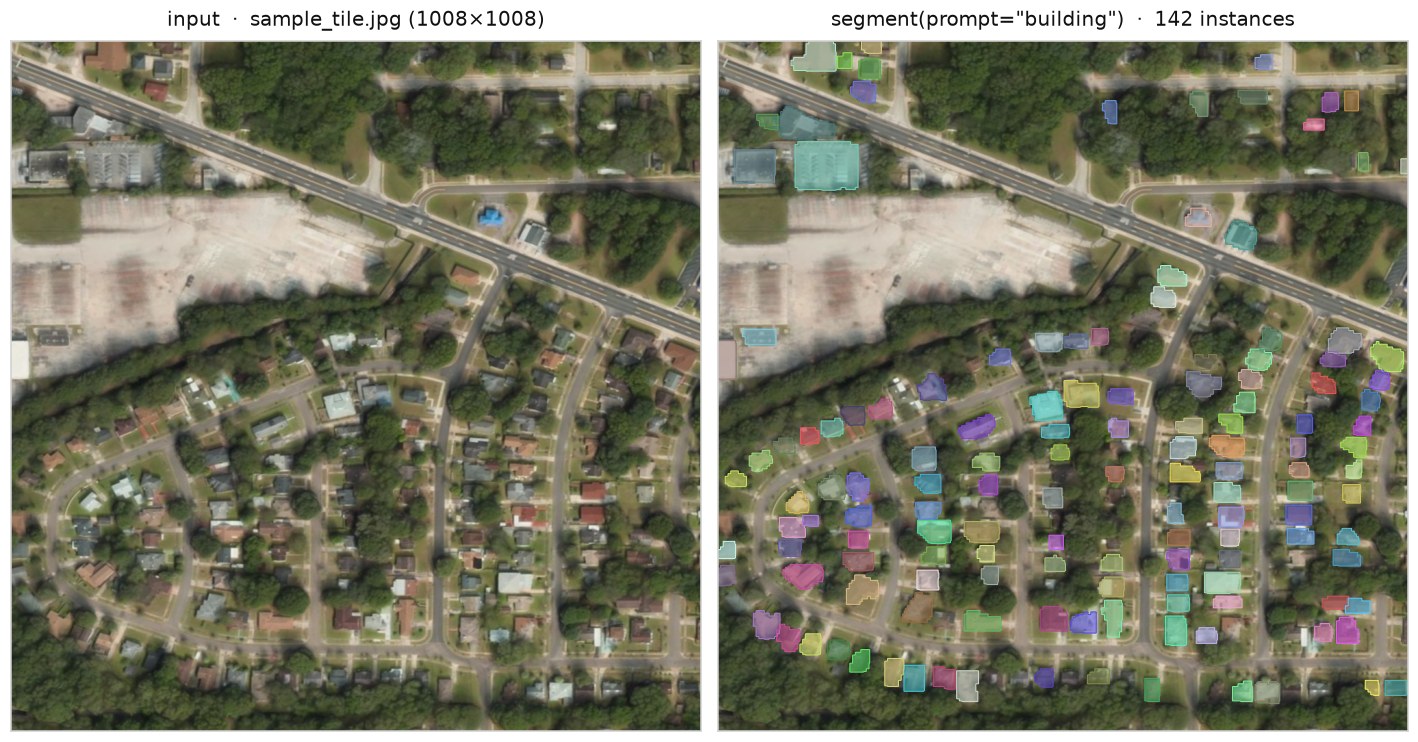
segment(tile, "building") → 142 instances.
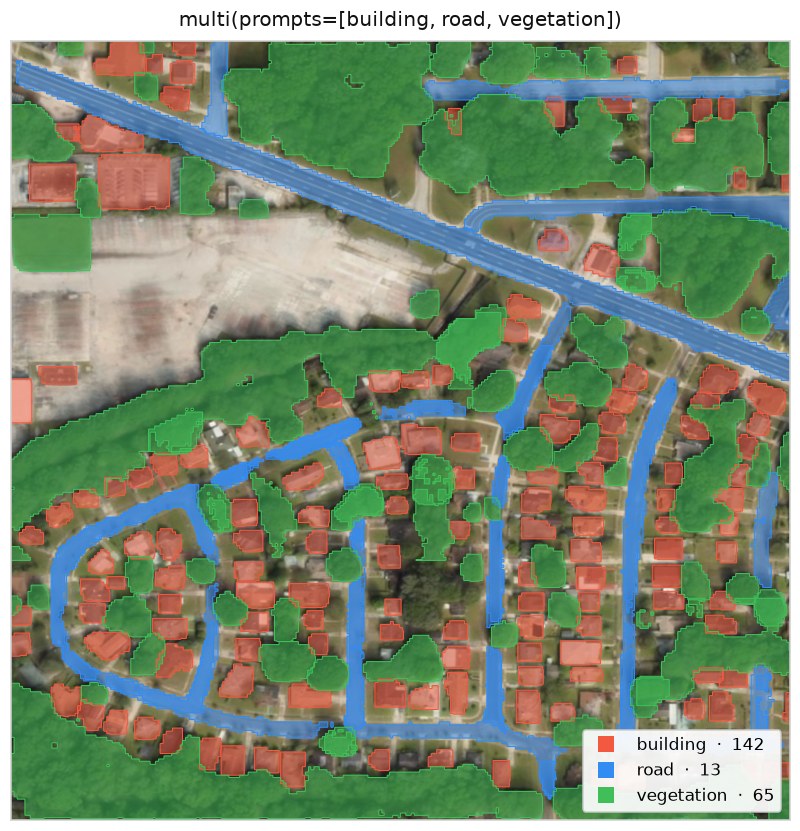
multi(tile, ["building", "road", "vegetation"]) → 142 / 13 / 65, one vision pass.
Export gotchas that might save someone time
aten::view_as_complex— the vitdet RoPE uses complex rotary embeddings ONNX can't represent.sam3_rope_patch.pyswaps in an algebraic real/imag rotation.aten::_pin_memoryNYI in the fake-tensor tracer — made identity (value-neutral host transfer).GuardOnDataDependentSymNodein the decoder — forcing the static-cache path avoids the assert-only guards.- The 0-box/0-point dummy prompt exports to a rank-mismatched
Addthat ORT rejects; passing one fully-masked box+point keeps text-only results identical.
The Python client
The repo also ships sam3_triton_client, so you're not hand-rolling gRPC tensor plumbing. It runs the BPE tokenizer, frames the image, and decodes the server's condensed RLE payload back into masks.
pip install ./clientfrom sam3_triton_client import Sam3Client
c = Sam3Client("localhost:8001") # gRPC; connect_timeout= blocks until models loadEverything returns a pandas.DataFrame with box ([x1,y1,x2,y2] in the original image's pixels), score, and a full-frame HxW mask — so results drop straight into pandas/numpy without any coordinate bookkeeping on your side.
Text prompt — all instances of a concept:
df = c.segment("sample_tile.jpg", "building") box score mask
0 [107.0, 0.0, 173.0, 44.0] 0.796 <1008x1008 px, 2277 fg>
1 [194.0, 59.0, 231.0, 90.0] 0.785 <1008x1008 px, 941 fg>
... 142 rows totalBox exemplars — steer the concept with examples in the same image. Not a spatial filter: a positive box means "things that look like this", a negative one suppresses an appearance.
c.segment(tile, "building", exemplar_boxes=[POS])                                  # 133
c.segment(tile, "building", exemplar_boxes=[POS, NEG], exemplar_labels=[1, 0])     # 132
c.segment(tile, None,       exemplar_boxes=[POS])        # pure visual query, no text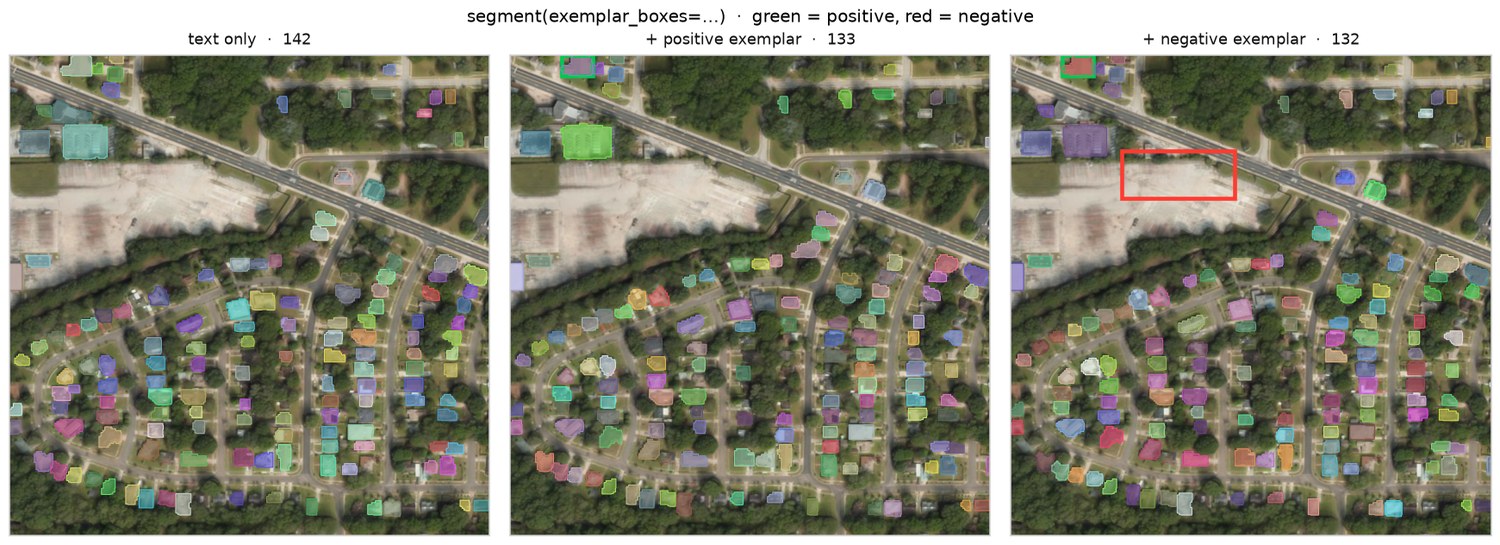
Multi-keyword — one encode, a keyword column on the way back:
df = c.multi(tile, ["building", "road", "vegetation"]) # 142 / 13 / 65Portable concepts — encode an appearance once, reuse it anywhere, including across processes:
concept = c.encode_exemplars(cropA, boxes=[[120, 80, 210, 160]])
open("concept.npz","wb").write(concept.to_bytes())        # bank it
df = c.segment(cropB, prompt=None, concept=concept)       # find it on a different crop
Interactive session — encode once, then cheap prompts; each call returns 3 candidates ranked by predicted IoU:
s = c.interactive(tile)
s.add_point((504, 504))                   # positive click        -> best IoU 0.845
s.add_point((470, 470), positive=False)   # negative refinement   -> best IoU 0.903
s.add_box([470, 480, 560, 545])           # box prompt            -> best IoU 0.709
s.add_mask(df.iloc[0]["mask"])            # seed from a segment() result, then refine by hand
s.undo(); s.reset()                       # reset keeps the cached embedding
df = s.everything(points_per_side=16)     # automatic mask generation -> 47 objects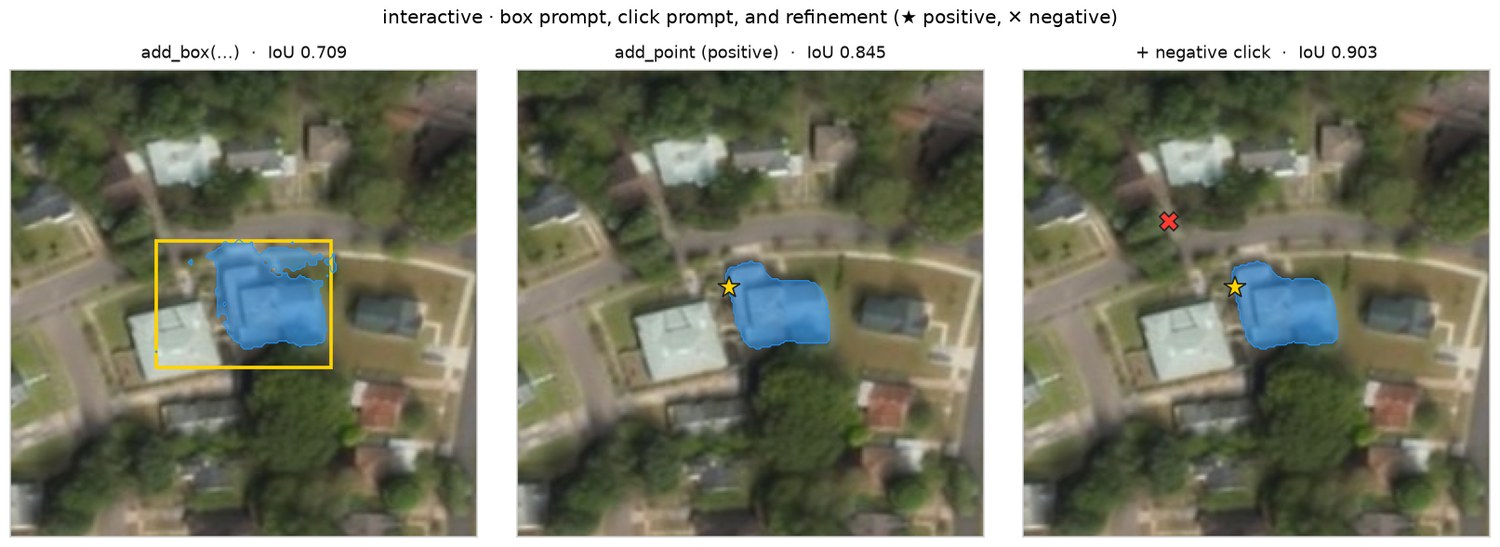
Other conveniences worth knowing:
- Any input dtype.
uint16/float rasters are percentile-stretched to 8-bit (robust to hot pixels), grayscale is replicated to RGB, alpha dropped — so 12-bit satellite tiles work without pre-conversion. - Client-side dedup. SAM3 grounding is set prediction with no server-side NMS, so at low thresholds it emits masks nested inside larger ones.
dedup=(default 0.85) suppresses those by overlap coefficientinter/min(area)— plain IoU-NMS misses them because the union stays large. - Per-request hyperparameters.
score_thr/mask_thr/max_detare optional ensemble inputs, so you tune without redeploying: on the sample tilescore_thr0.2/0.3/0.5/0.7 → 153/142/93/17 instances. - Connection handling. round-robin LB (point it at a headless Service to spread across pods), gRPC-native retries for transient transport errors only, and
connect_timeoutto block through a cold start — a full SAM3 load is ~60–90 s.
Caveats
- Image model only — no video, tracking, or memory propagation.
- fp32. The ViT correlations overflowed fp16 in my testing.
- Fixed 1008 image input and 32-token text; other sizes need a re-export.
- No weights shipped — the repo is tooling; you run the export against your own checkpoint, and SAM3 itself stays under Meta's license.
Happy to answer questions on the split or the Triton configs. Disclosure: this is my repo.
Source: facebookresearch/sam3