Performance/scalability?
Hey there,
First off, thank you for sharing your paper (A Conflict-Free Replicated JSON Datatype) and this library with the world.
I started playing with automerge this afternoon and wanted to run some basic tests to see if I could use it for the federated personal web site system I’m working on, as I want it to work offline and I’d rather not privilege servers over clients (the goal is, ideally, for this to be a stepping stone towards a p2p world, which I believe is what we’re all working for) :)
So to cut to the chase, I wanted to share my very unsophisticated findings and to also inquire about whether, in the words of Steve Jobs, I’m “holding it wrong” :)
Multiple inserts
Code: https://source.ind.ie/snippets/80
I first tried pushing incremental numbers to an array in a document via the change() method. The timings (on my MacBook) ranged from 6ms for 1 push to 43.75 seconds for 10,000. 100 pushes took 175ms and 1,000 took 1.345 seconds.

The storage requirements (tested very roughly using util.inspect to flatten the object, including all hidden fields) also seem to follow a similar curve. A single insert took up 3,557 bytes (size of original object: 18 bytes), 10: ~17KB, 100: ~160KB, 1,000: ~1.6MB, and the array with 10,000 numbers took up ~ 16MB (size of original object: ~80 bytes). Again, my testing methodology doesn’t necessarily reflect the actual amount of space these objects would take up either in memory or on the file system but, unless I’ve done something really daft (which is always a possibility), it does look like the system would result in a sluggish interface on operations on an array with ~100 items or so.
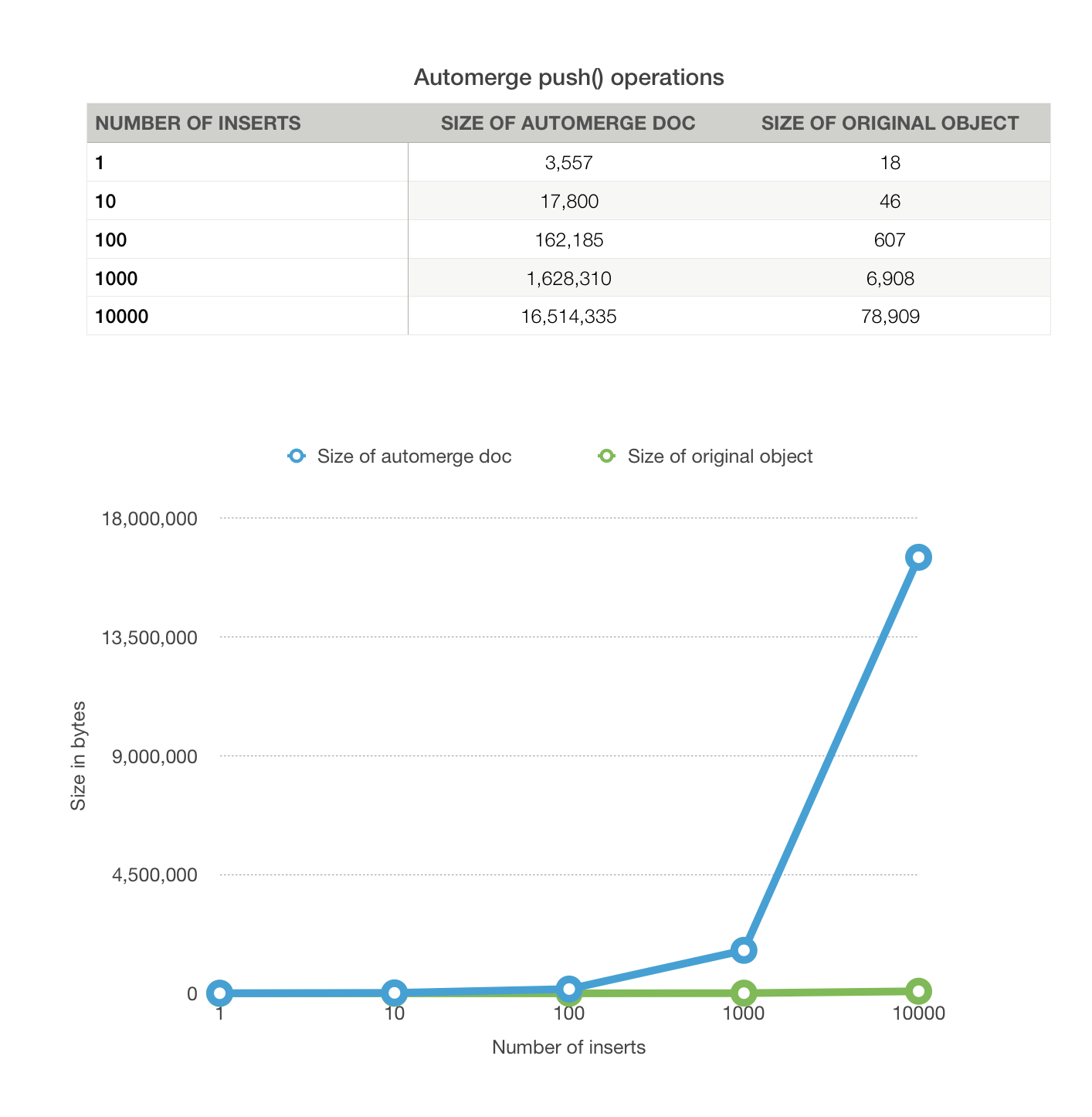
Single insert
Then I thought maybe I am holding this wrong and it is meant to be used with batch inserts.
Code: https://source.ind.ie/snippets/81
So instead of testing, say, 10,000 pushes to an array, I wanted to test a single change to the object where an array with 10,000 items is added.
The results I got mirror those of the first scenario.
The timings seem to follow a similar curve at first but the results I got for the array with 10,000 items was ~3x slower at ~115 seconds vs ~43 seconds using the first technique.

As for the document sizes, they came out to be slightly less than with the first technique from the 100 item mark onwards. It was still ~1.3MB for 1,000 items and ~13MB for 10,000.

I’d love to hear your thoughts on this as well as any criticism of the above (including what I was benchmarking and how). My use case is a personal web site allows both posts and messaging between sites. I was using the 10,000 item test as an upper limit for initial use (e.g., 10,000 posts in a category, 10,000 messages in a conversation.) A more realistic amount might be 20-30 to a few hundred. But even at those levels, the latency would require operations to take place outside of the main thread to avoid a sluggish UI.
Also, since Automerge is already being used in two real-world applications, I’d love to hear of your actual experiences with performance, scalability, and storage requirements.
Thanks again for making this and sharing it. It’s a very hard problem domain indeed.
Update
Based on the feedback of @pvh and @j-f1 (thanks, folks!), I just updated my tests to include:
A key setting test (as opposed to array.push()) – the results are generally comparable to the previous ones:


And to use Automerge.save(doc) to test storage size (the sizes are 3x-5x smaller):

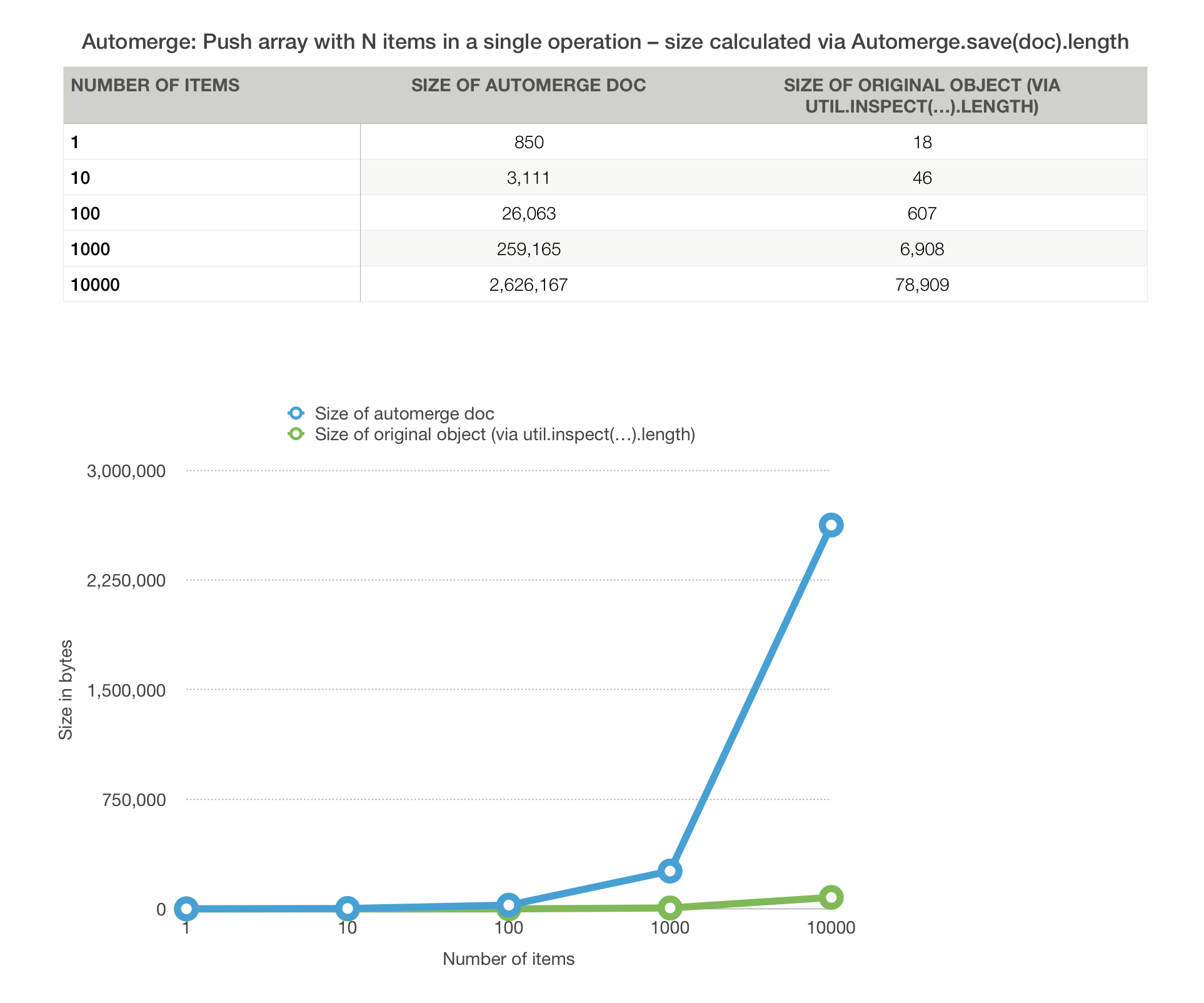

I’ve added the test files to their own repository at https://source.ind.ie/indienet/spikes/crdt/automerge
Source: automerge/automerge-classic