Multi-agent work in three spoonfuls III: a memory that leaves traces
Status of the demo. The viewer was regenerated on August 29, 2026 from a sanitized public projection (with the non-public bits stripped out 😀): the artifact contains no mail bodies, attachments, addresses, absolute paths, tokens, credentials, or microdata. Preamble: remembering is not enough In the second part I went after a bounded problem: getting 's memory to retrieve evidence and to recognize when it had found none. The question in this third part is more practical, and it comes out of the system having been in use for a while: what happens to a memory as it grows and turns blurry, or even contradictory? An index can pile up fragments without any trouble, and there are plenty of tools that already do that well. A more useful memory, in my judgment, has to carry provenance, currency,...
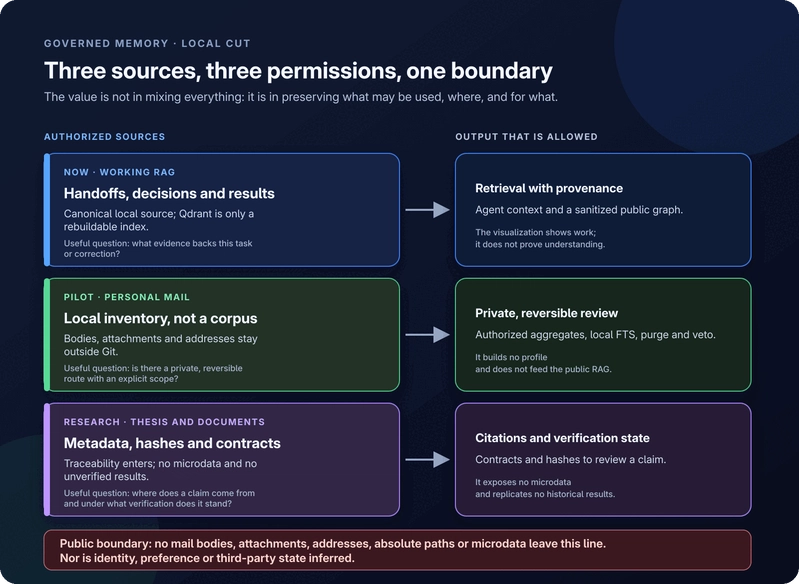
Status of the demo. The viewer was regenerated on August 29, 2026 from a sanitized public projection (with the non-public bits stripped out 😀): the artifact contains no mail bodies, attachments, addresses, absolute paths, tokens, credentials, or microdata. Preamble: remembering is not enough In the second part I went after a bounded problem: getting 's memory to retrieve evidence and to recognize when it had found none. The question in this third part is more practical, and it comes out of the system having been in use for a while: what happens to a memory as it grows and turns blurry, or even contradictory? An index can pile up fragments without any trouble, and there are plenty of tools that already do that well. A more useful memory, in my judgment, has to carry provenance, currency, permissions, contradictions, and deletion criteria. It also has to tell finding a source apart from using it correctly. Recent literature insists on separating RAG — retrieval-augmented generation — context management, and agent memory, because they do different jobs and call for different evaluations 1. What follows has three movements: what changed since part II; which experiments survived a more serious evaluation; and how to show a memory without passing it off as a mind. Spoonful 1: from retrieving fragments to governing evidence In part II the problem was retrieving well: finding the relevant context and recognizing when there was not enough evidence. A useful memory does not only retrieve information; it also has to know where it came from, whether it still holds, where it can be used, and what is allowed to be done with it. RAG mostly solves retrieval. The memory layer adds rules for keeping, updating, relating, or discarding evidence. None of those functions amounts, on its own, to identity. To describe provenance I use concepts compatible with PROV-O — entities, activities, and agents — while currency, sensitivity, and permissions need rules of their own 2. What changed since part II Open item from II What exists now What is still open Compare dense retrieval, lexical retrieval, and reranking. A frozen cut of 319 contexts and 40 queries evaluated at . The best configuration gets 38 complete cases and 2 partials; the strict gate stays shut. Check that an answer uses its sources and knows how to abstain. The contract, with 12 positive and 6 negative cases, all sanitized. The end-to-end evaluation with a local model and the reserved human review are unfinished. Add currency without erasing history. The proof of concept admits only toward later versions and rejects competing successors. There is still no temporal reasoner wired into live memory. Show growth without turning the graph into truth. A 3D viewer, regenerable from sanitized JSON and accompanied by a text alternative. The viewer neither validates relations nor represents a mind. The difference may look small, but it changes the question. Knowing which fragment sits close to a query is no longer enough; what matters as well is what kind of evidence it is and under what conditions it can be reused. What memory actually exists The PoC brings several layers together, but does not treat them as equivalent: experience: 16,955 indexed points and 1,432 strategies make it possible to explore actions, corrections, and failures. Semantic closeness proves neither causality nor truth. Curated context: 319 canonical records make it possible to retrieve handoffs and decisions with their provenance. The index helps to find them, but does not replace the original record. Research process: a projection with 796 derived artifacts and 533 links makes it possible to inspect the work trajectory without publishing documents or microdata. Personal mail: the local inventory holds 12,072 unique messages between 2011 and 2026. It serves to test reading and deduplication within an authorized scope; it is not a public corpus and not a personality model. Experimental personal memory: a separate prototype tes