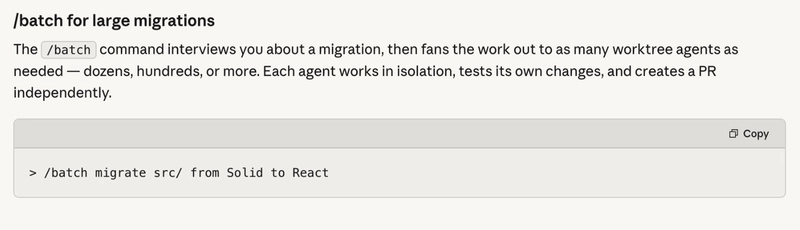
Last week, it came to light Cursor had mostly finished migrating from SolidJS to React.
This migration happened about seven months ago.
But it became a central focus of discussion following the Solid 2.0 RC release.
Then yesterday, a week later, it came to my attention that the Anthropic docs example command for their large-scale migration feature is: I admit that my gut reaction was not great.
Out of all the examples they could have chosen...
Years of my work became a canonical example of the thing you migrate away from — in the same week we shipped the biggest release in the project's history — stung in a way I won't pretend it didn't.
My second reaction was to assume that, like the other trickle-down posts I'd seen this week, this rode the same week-old news cycle.
Then I checked the Internet Archive and realized this has been there since at least April
2026.
Four months before the Cursor story broke.
At this point, the whole public footprint was a mention of an experiment sandwiched between bigger updates in a Cursor blog post posted in January.
The kind of thing that no one outside the industry would even really pick up on.
No reasoning, no benchmarks, no argument.
Stop to think about what that means.
I should be careful here because I can't prove anyone at Anthropic ever read that Cursor post.
Nobody can.
Maybe a docs writer saw the experiment.
Maybe Claude drafted its own example.
But think it through.
Either it traveled from a buried line in one company's release notes into another company's official docs, or it needed no origin at all.
It was already assumed before any public migration existed.
Our industry has quietly started broadcasting conclusions where it used to transmit arguments.
We couldn't have picked a worse time, because — as I'll get to — arguments are the only source that still matters.
Why This Matters More Than It Used To It would be fair to ask, hasn't it always been like this?
Teams cargo cult large players.
Netflix or Facebook uses this predates AI by decades.
Optics and politics have always beaten pure technical merit.
The weight of Facebook definitely helped React's early propagation.
But a narrative used to come with friction.
It was always in the race, but it couldn't outrun the argument.
This has changed for two reasons: First, execution cost has collapsed.
Bun's rewrite from Zig to Rust — a million-ish lines — was executed almost entirely by Claude agents in days, not months.
And before you start thinking "lock-in", going the opposite way, while not as easy, has never been easier.
Migrating from Rust to Zig or React to Solid has never been easier.
That sounds like good news.
And it is.
When migrations took years of human effort, cost put a damper on fashion.
Now execution is a lot cheaper in all directions.
The only thing left is the reason.
Which suggests, on the surface, these decisions should be rooted in technical merit.
But when narrative is what sets the direction, you start to see how a line buried in documentation is worth an essay.
Second, verdict production has been industrialized.
Cognition just migrated its marketing site from Astro to Next.js.
A content site.
Astro's home turf, by near-universal consensus, including from people with no stake in the fight.
The migration was performed by Devin itself and published as a case study: the agent made the changes, tested them, recorded its own verification runs.
No repository, no before-and-after numbers, no benchmark.
The output wasn't the site.
It was the story.
And believe me, there is no shortage of these stories.
Migrations are now the demo genre of the agent industry.
Theo Browne was trying to tell me this a couple weeks back with some very good advice.
But it hits a lot harder when you feel it firsthand.
Migrations that demo flawlessly are, by definition, the ones moving toward what the agent writes best today.
Marketing departments are generating "X → dominant library" verdicts at a rate organic engineering decisions never would.