Compare vLLM and Ollama for LLM serving in 2026 — architecture, verified performance under concurrency, and a decision framework for choosing or combining them.
Two Tools for Two Very Different Jobs If you have run a large language model locally in the last two years, you have almost certainly touched Ollama.
It is the tool that made local LLMs approachable: install it, pull a model, and run a chat in minutes.
If you have served a model to hundreds of concurrent users in production, you have almost certainly touched vLLM.
It is the workhorse behind many hosted inference platforms, built from the ground up for throughput at scale.
The mistake most people make is treating them as interchangeable.
They are not.
They are built for different workloads, different concurrency profiles, and different priorities.
This guide explains the architecture that makes them different, shows the verified performance gap under real conditions, and gives you a decision framework for choosing — or combining — them in
2026.
The short version: at a single concurrent user, Ollama is simpler and can even be slightly faster.
The moment you add concurrency — multiple users, parallel requests, a front-end app — vLLM pulls ahead, and the gap grows with the number of simultaneous requests.
What Each Tool Actually Is vLLM: a production serving engine vLLM, developed at UC Berkeley's Sky Computing Lab, is a high-throughput inference and serving library written in Python.
It is not a "runner" that wraps a backend; it is a full serving stack with its own scheduler, memory manager, and batching engine.
Its two signature ideas are PagedAttention and continuous batching.
PagedAttention manages the KV cache — the memory that stores prior tokens during generation — the way an operating system manages pages of RAM.
Instead of allocating one contiguous block per request, it stores tokens in fixed-size blocks that can point to non-contiguous memory.
This eliminates the memory fragmentation that wastes up to 60-80% of KV cache in naive implementations, letting far more requests share the same GPU memory.
Continuous batching goes further: instead of waiting for a whole batch of requests to finish before starting the next, it lets requests join and leave the batch as they complete.
A request that finishes early frees its slot immediately, and a new request joins right away.
This keeps the GPU saturated instead of idling while stragglers finish, and is the single biggest driver of vLLM's throughput advantage. vLLM supports 200+ model architectures and scales across multiple GPUs with tensor, pipeline, data, expert, and context parallelism.
Ollama: a local runner built on llama.cpp Ollama is a Go-based application that runs open-source models locally, built on the llama.cpp engine (with MLX support for Apple Silicon).
Its entire design philosophy is simplicity: a clean CLI, a small API, and models distributed through its registry.
It was built for the developer sitting at a terminal, running a model on one machine, chatting with it directly.
That simplicity has a cost.
Ollama is not designed for high concurrency.
Its parallelism is capped by the environment variable, which defaults to 4, and its scheduling model does not aggressively batch work the way vLLM does.
For a single interactive user this rarely matters.
For a service behind a load balancer it becomes the bottleneck.
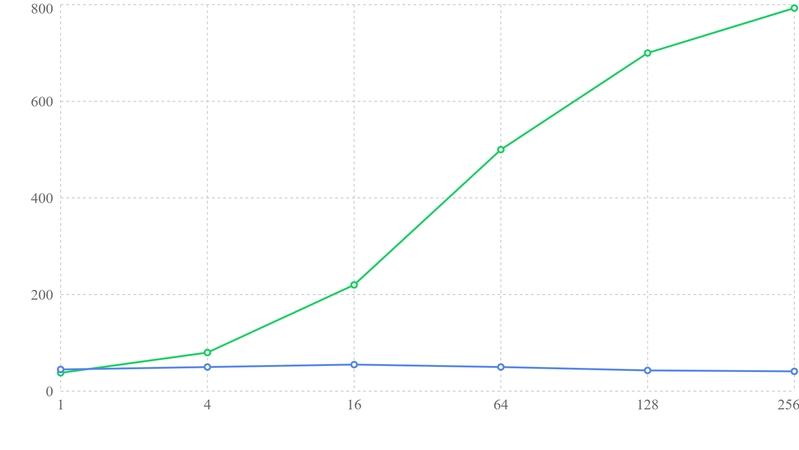
The Verified Performance Gap The most reliable independent benchmark available compares Ollama and vLLM serving Llama 3.1 8B on an NVIDIA A100 40GB across a concurrency range from 1 to 256 simultaneous requests.
The results are unambiguous.
At a single request, the two tools are close.
As concurrency rises, vLLM's continuous batching and PagedAttention take over, and the gap widens to nearly 20x at high concurrency: vLLM peaked around 793 tokens per second against Ollama's 41 tokens per second, with 99th-percentile latency of 80ms versus 673ms.
Notably, Ollama remained behind even when its parallel limit was raised to
32.
Illustrative throughput vs concurrency for Llama 3.1 8B on A100 40GB.
At single user they are close; under concurrency vLLM pulls ahead dramatically.
Values approximate the Red Hat benchmark pattern.
The exact multiplier depends on the model, GPU, and workload — it is not a universal constant.
A 2026 benchmark on an A100 80GB with Llama 3 8B found vLLM about 2.3x faster at 8 concurrent users (187 vs 82 tok/s) after Ollama actually edged ahead at a single user (45 vs 38 tok/s).
Another test with a dual-GPU Qwen3 14B setup measured vLLM up to 3.2x ahead at 128 concurrent requests.
Two things are consistent across every source: at one user the tools are comparable, and under real concurrency vLLM wins by a large margin.
Anyone repeating the claim that "vLLM is 20-29x faster" should treat that as a high-concurrency figure on a specific workload, not a general rule.
Feature Comparison Feature vLLM Ollama Primary use High-throughput production serving Local dev / single-user chat Continuous batching Yes (default) No (capped parallelism) PagedAttention Yes (core design) No OpenAI-compatible API Yes (+ Anthropic, gRPC) Yes (via /v1, no stateful) Multi-GPU / distributed Yes (tensor/pipeline/data/expert) Limited (single node) Quantization support GGUF, GPTQ, AWQ, FP8, MXFP8 GGUF (Q4_K_M, etc.) Concurrency control Dynamic scheduler OLLAMA_NUM_PARALLEL (default 4) Setup complexity Higher Very low Language Python Go (llama.cpp backend) Approximate relative throughput advantage of vLLM over Ollama as concurrency grows (1x at single user to ~19x at high concurrency).
Illustrative, based on the Red Hat benchmark.
The Key Calculations Token throughput Throughput is the number of tokens generated per second across all requests combined.
It is the metric that matters for cost and capacity: throughput=timetokensgenerated vLLM maximizes throughput under load by keeping the GPU saturated via continuous batching.
Ollama's throughput plateaus because its parallelism cap and less aggressive batching leave GPU capacity idle between requests.
Latency percentiles For interactive applications, the 99th-percentile latency (P99) matters more than the average, because it reflects the worst experience a user actually gets.
Under concurrency, vLLM's P99 stayed at ~80ms while Ollama's degraded to ~673ms — the tail latency of Ollama under load is an order of magnitude worse.
Cost per token at scale The practical consequence is cost.
At 100 concurrent users, the number of GPU-seconds required to serve a fixed request volume is far lower on vLLM because it packs more work into each GPU.
This connects directly to the Local LLM Break-Even Calculator: the throughput a framework extracts from your hardware determines how much self-hosting actually saves you.
The KV cache: where concurrency lives or dies The fundamental resource that limits concurrent inference is not raw compute — it is the KV cache , the memory that holds the key-value representations of every token processed so far in a generation.
Each active request holds its own KV cache for the duration of its generation, and with many concurrent requests the total can dwarf the model weights themselves.
Naive serving allocates one contiguous block of KV memory per request up front.
Because requests generate different numbers of tokens at different rates, these blocks are mostly wasted: a request that finishes early leaves its reserved memory idle, and fragmentation prevents the freed space from being reused efficiently.
This is where vLLM's PagedAttention is decisive.
By splitting the KV cache into fixed-size blocks that can be scattered across memory and shared between requests, it eliminates most of that fragmentation, letting a far larger number of requests coexist on the same GPU.
The practical formula for sizing a server is therefore: VRAMtotal≈W+KVperrequest×C Where W is the model weights, KVperrequest is the KV cache per active request (proportional to context length and model